Brush Clearing 101: Real Costs and Who to Hire
Small patch of brush driving you crazy? Learn what small yard brush clearing really costs, when a big land-clearing crew makes sense, and how to hire the right pro.
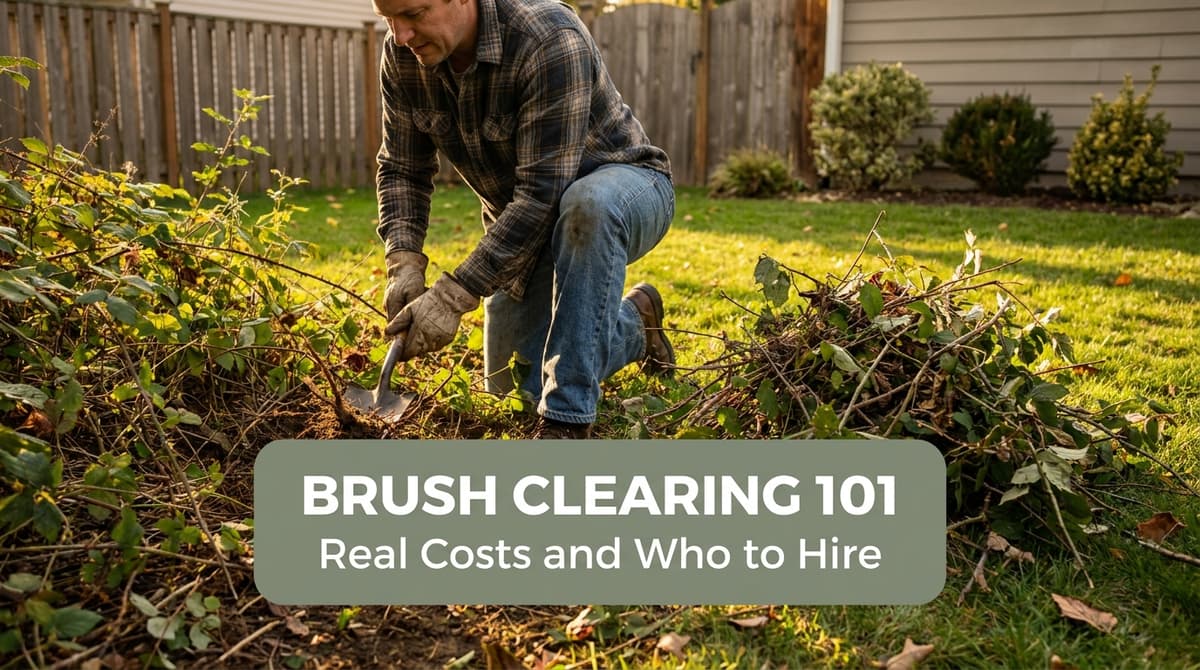
Brush Clearing 101: A Real Call That Says It All
We recently got a call from a homeowner — let's call her Debra — who had a classic small-yard problem. She lives on about a quarter-acre lot, and behind her fence there was a patch of brush “about the size of a large garden.” It wasn’t huge, but it was tall and scraggly enough to make her yard feel overgrown and irritating to look at.
Debra asked if we could come out and give her a quote on clearing it. After listening to what she described, we had to be honest with her: it wasn’t that the job was impossible — it was that our type of company wasn’t the right fit, and hiring us would’ve cost her a lot more than it was worth.
That conversation with Debra is exactly why we wanted to write this guide. Small brush-clearing jobs can fall into a weird in‑between zone where some contractors are too big, but you still need more than a pair of pruning shears. Let’s break down what these jobs really cost and who you should hire.
Why Larger Land-Clearing Companies Have Higher Minimums
On the phone with Debra, we explained that our company has a $1,500 minimum. Our rate is around $250 per hour with a six-hour minimum, whether we’re out there for the full six hours or not.
When homeowners hear that, especially for a small job that might only take 30 minutes, it can sound crazy. But here’s what’s going on behind the scenes for larger land‑clearing outfits like ours:
- Expensive equipment: Skid steers, mulchers, and brush cutters cost a lot to buy, maintain, and insure. Those costs don’t change just because the job is small.
- Mobilization time: We have to load machines, haul them to the site, unload, do the work, reload, and drive back. Even a “quick” job can eat up half a day.
- Labor and insurance: We’re paying employees, not doing side work on weekends. Payroll, workers’ comp, general liability, fuel — it all adds up before we clear a single branch.
- Business overhead: Office staff, licensing, maintenance yards, and equipment storage all have to be covered in that minimum.
For a big clearing project, those costs are spread over many hours, so the pricing feels reasonable. For a small garden-sized patch like Debra’s, the same overhead makes the price feel out of proportion to the work.
What Counts as a “Small” Brush-Clearing Job?
It helps to know where your project falls on the spectrum. Based on what we see daily, here’s how we’d classify jobs:
Good candidates for a small lawn/landscape crew
- Brushy area is about the size of a large garden up to roughly 1,000–2,000 square feet
- Brush is mostly tall grass, small saplings, vines, and brambles
- No major grading or dirt work needed afterward
- Access is reasonable — a push mower, trimmer, or small walk‑behind brush cutter can get in
- No large trees (say, over 4–6" in diameter) that need removing
That was Debra’s situation exactly: small area, light to medium brush, no major tree work. For that kind of job, a local lawn mowing or small landscape crew is almost always the best value.
Better suited for a large land‑clearing company
- Areas bigger than a backyard or multiple connected lots
- Heavier brush, thick saplings, or small trees throughout
- Steep slopes, rough terrain, or poor access for small equipment
- Need to remove stumps, regrade the soil, or prep for construction
- Time-sensitive projects where you need a lot done quickly
Once you’re in that range, our larger machines and crews start to make financial sense. The hourly rate might be higher than a lawn crew’s, but we can clear a lot more ground in the same amount of time.
Typical Costs: Small Yard Jobs vs. Big Equipment
Debra estimated her patch would take about 30 minutes to clear. She was probably right. Here’s how the pricing usually shakes out for jobs like that:
Small lawn / landscape crew pricing
Every company is different, but for a small brush patch, we typically see:
- Minimum trip charge: Often in the $100–$300 range
- Hourly rates: Maybe $50–$100 per person per hour, depending on their equipment
- Half-day jobs: Something like $300–$600 total for a few hours of work
For a “large garden” sized patch, you might be toward the lower end of that range if access is good and disposal is easy.
Large land‑clearing company pricing
For companies like ours, minimums are usually higher because of the equipment and overhead:
- Hourly rate: Often $200–$300+ per machine hour
- Minimum hours: Commonly 4–8 hour minimums
- Typical minimum invoice: $1,000–$2,000+, depending on the company and equipment
That’s why we told Debra, very frankly, that we’d hate to charge her $1,500 for a 30‑minute job. We would literally be overkill for what she needed.
How to Get Good Value on a Small Brush-Clearing Project
So if you’re in Debra’s shoes, how do you keep things affordable and still get the job done right? Here are some strategies we recommend to homeowners all the time.
1. Look for lawn crews that do “odd jobs”
Many mowing crews are happy to pick up side work like leaf cleanups, small brush clearing, and garden tear‑outs, especially if:
- They’re already in your neighborhood
- Rain cut a week short and they want to make up hours
- You’re flexible on scheduling
For them, a small job “wets their beak,” as we told Debra — it’s enough extra income to be worth their while without requiring huge equipment.
2. Combine projects into one visit
If you only have one tiny patch of brush, the trip charge can be a big percentage of the total price. You can improve the value by:
- Bundling in leaf cleanup, hedge trimming, or gutter cleaning
- Having them haul off a small brush pile or yard debris at the same time
- Scheduling with neighbors so the crew can do multiple yards in one trip
The more work you can reasonably bundle into one visit, the better your cost per task tends to be.
3. Ask clear, specific questions
When you call around, here are a few questions that help you compare apples to apples:
- “Do you have a minimum charge, and what does it include?”
- “Does your price include hauling away the brush, or is that extra?”
- “Will you chip, mulch, or leave debris in a pile for me?”
- “Can you send a couple of photos via text or email for a ballpark estimate?”
For tiny jobs, many contractors can give a very close estimate from photos, which saves them a trip and saves you an extra fee.
When You Should Call a Bigger Crew Anyway
There are times when even a relatively small area really does call for a larger land‑clearing company like ours:
- You suspect there are hidden hazards (concrete, metal, old fencing) in the brush
- You need to clear brush around structures or utilities and want a fully insured, specialized crew
- The property is uneven, wet, or steep, making it dangerous for smaller equipment
- You’re prepping for construction and need trees, stumps, and brush all handled together
In those situations, the higher minimum is buying you not just time and equipment, but also experience, safety, and liability coverage.
Not Sure Where Your Project Fits? Start with an Honest Conversation
When Debra called, we could have said “sure” and taken her money, but it wouldn’t have been right. We walked her through exactly why a small lawn or landscape crew would be a better fit and how to look for one that handles jobs like hers.
If you’re staring at a patch of ugly brush and wondering whether you need a big land‑clearing company or just a couple of guys with trimmers, start by describing the size, thickness, and access as clearly as you can. A reputable contractor — big or small — should be willing to tell you honestly if they’re the right fit or if someone else can give you a better bang for your buck.